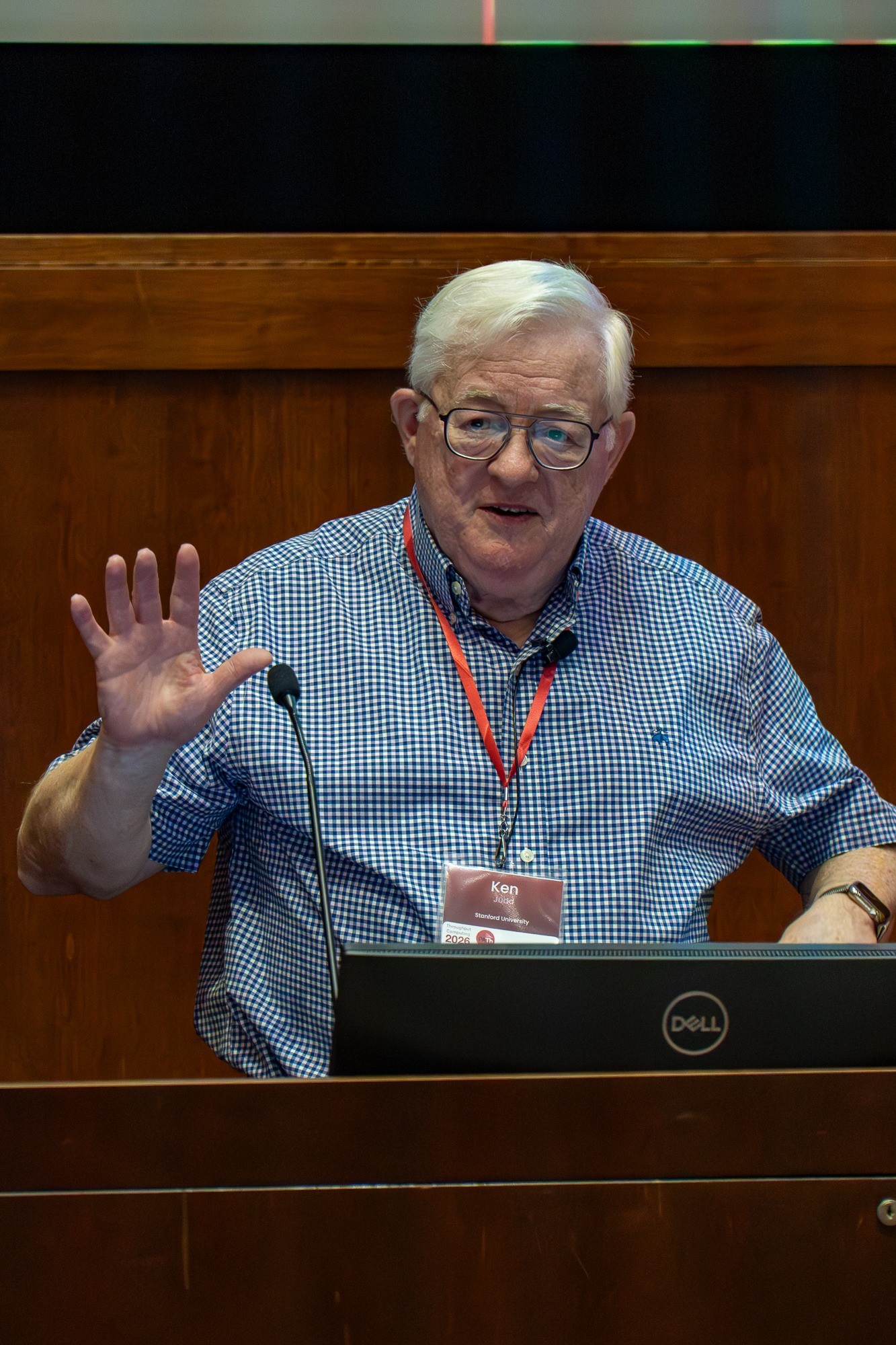
“How can HTCondor be used for economics?” asked Dr. Kenneth Judd, Senior Fellow at the Hoover Institution, when he presented his work on using high throughput computing (HTC) to model climate policy, and how the field of economics can utilize HTC. While presenting at High Throughput Computing Week 2026 (HTC26), Judd shared that he first started using HTC and HTCondor, a workload management and job scheduling system developed by the Center for High Throughput Computing (CHTC), in his research work 20 years ago. This connection to CHTC followed after he realized that there were no comparable resources available at Stanford for his Stanford PhD student. Judd reached out to CHTC Director Miron Livny, who directed the provision of OSPool “unlimited access at zero priority” to HTCondor.
Judd’s answer to transforming how economists do research is breaking up big problems in economics into many smaller ones, and solving them across an HTC grid using a wavefront abstraction. Wavefront abstractions break a big problem into a grid of small pieces, where each piece needs the answers from its neighbors before it can be solved. Wavefront abstraction can be supported by HTCondor functions condor_master or DAGMan to solve massive problems in economics.
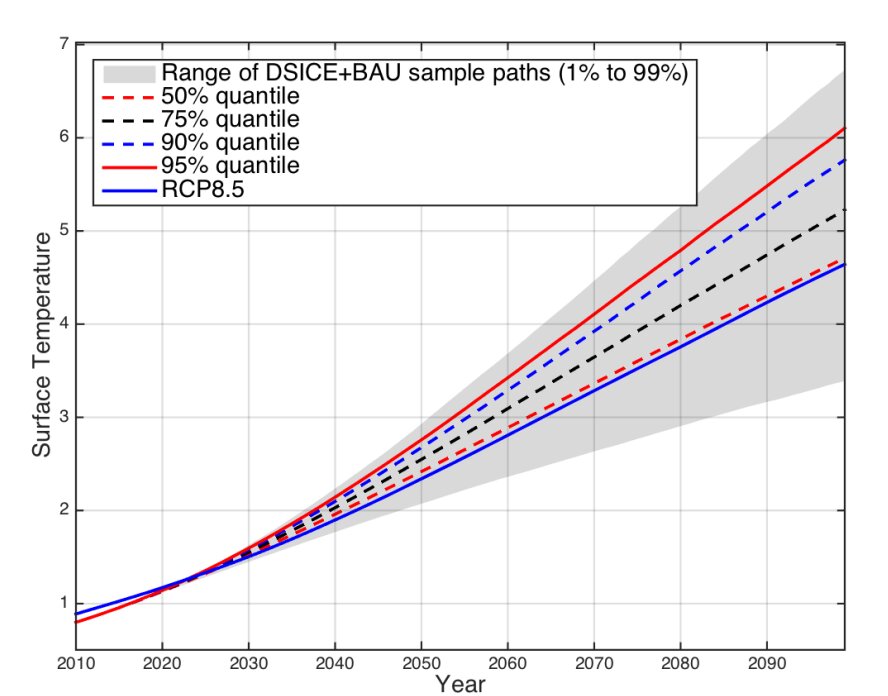
Previous economic models generally assume that the economy is perfectly predictable, a framework that clashes with the vast amount of uncertainty pertaining to the climate. Judd wanted to look at more complex models that can account of degrees of uncertainty, so in partnership with Yongyang Cai, developed the Dynamic Stochastic Integration of Climate and Economy (DSICE) framework, a large computer model that simulates how the economy and climate affect each other over time, accounting for uncertainty in climate behavior and economic growth. After developing the model and running simulations, they found the median case would show a three degree fahrenheit increase in temperature by 2100, matching basic deterministic models. However, because of the added variables accounting for uncertainty, Judd and his colleagues actually found there is a much higher risk of greater than six degrees warming that other models not accounting for uncertainties that fail to display, what Judd calls “the risk of really bad events.”
Judd noted that there are several types of computational problems in economics that can be greatly benefited by using HTC. Large problems, like constrained optimization or systems of polynomials, can be broken down in smaller connected pieces and solved using HTC tools and wavefront abstraction.
Judd presented an example of dynamic programming performed using HTCondor through a paper he co-authored “Solving Dynamic Programming Problems on a Computational Grid.” Judd and his colleagues used the condor_worker function of HTCondor to manage a portfolio to maximize the value of wealth at retirement time t. Cai and Judd used up to 200 CPU’s, solving dynamic programming problems at scale not possible before.
Judd’s goal moving forward is to develop useful software accessible to economists, a task he says is a challenge in a field not used to utilizing modern computational methods. Judd remarked “There’s a lot of low hanging fruit” in economics, which he says HTCondor and OSG can be extremely helpful for.